Leveraging Indigenous Storytelling For Disability Inclusive Education in Africa
By Rotarian Dr Do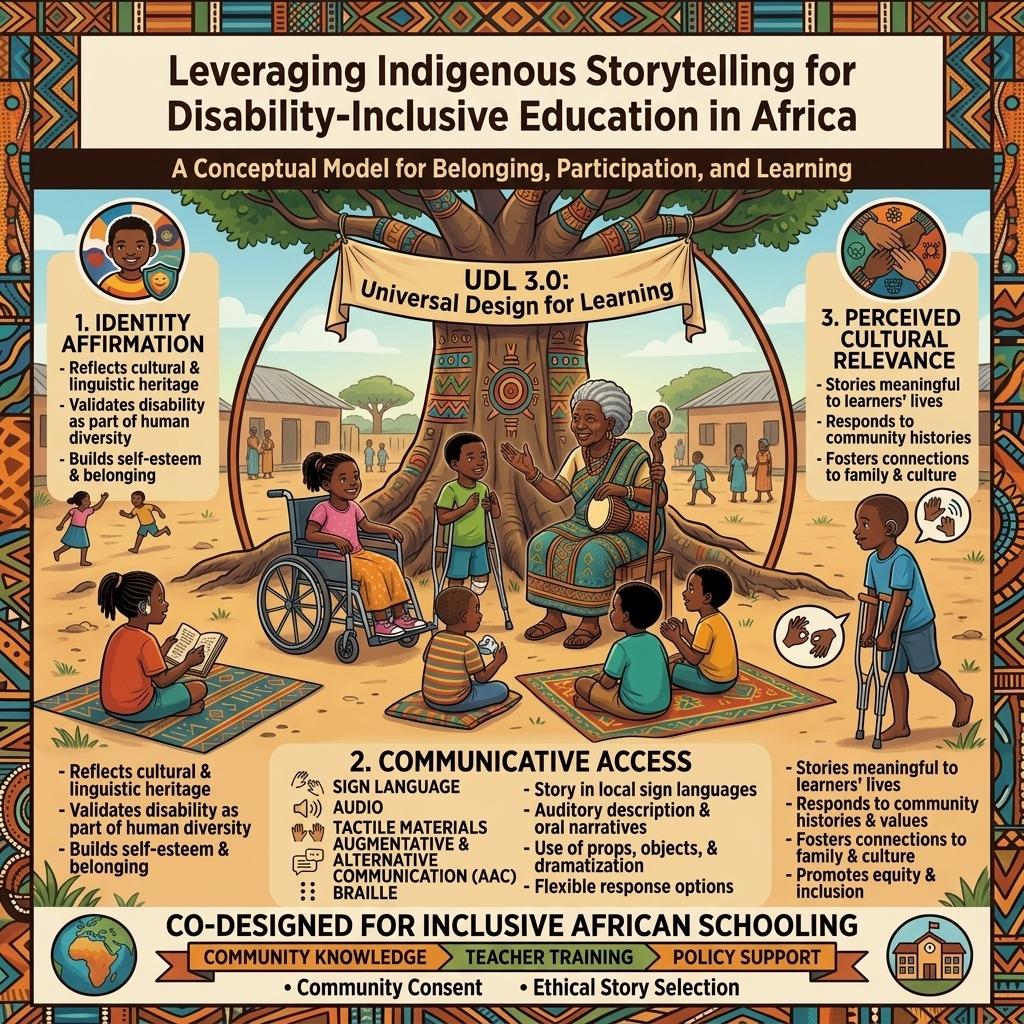 reen Myrie
Rotarian Donna Guerin
Inclusive education is a global commitment, yet its success depends on how well schools respond to local histories, languages, and the lived experiences of disabled learners. In African contexts—rich with diverse cultures, oral traditions, and multilingual realities—Indigenous storytelling offers a promising but often misunderstood pathway toward more inclusive learning. This article explores a new conceptual model that explains how culturally grounded storytelling, when intentionally designed and co‑created with communities, can strengthen access, participation, identity, and belonging for students with disabilities.
Indigenous Knowledge Systems: A Plural Landscape
Indigenous Knowledge Systems (IKS) across Africa are not a single tradition but a constellation of community‑specific ways of knowing. They include ecological wisdom, social values, artistic expression, spirituality, and oral narrative. Storytelling is one expression of IKS, but its forms, languages, and social roles vary widely.
Crucially, storytelling is not automatically inclusive. Some narratives may reinforce stigma, gender hierarchy, or ableist tropes. A decolonizing approach asks:
- Who selects the story?
- Whose language is used?
- Who has authority to interpret or adapt it?
- Does the narrative affirm or marginalize disabled learners?
Storytelling becomes valuable only when these questions are addressed with care.
Culturally Responsive Teaching Meets UDL 3.0
Culturally responsive and culturally sustaining pedagogies emphasize relevance, linguistic diversity, and learner agency. Universal Design for Learning (UDL 3.0) adds a flexible design architecture that centers variability, identity, and multiple ways of knowing.
Together, these frameworks shift storytelling from a “traditional activity” to a deliberate design choice. UDL‑aligned storytelling may include:
- Spoken or signed narration
- Visual supports, objects, or dramatization
- AAC tools, tactile materials, or digital formats
- Learner‑created counter‑stories
- Multiple ways to respond or demonstrate learning
The goal is not to match stories to disability labels, but to remove barriers and expand access.
A Storytelling‑for‑Inclusion Logic Model
The conceptual model proposes three mechanisms through which storytelling can support inclusion:
- Identity affirmation – learners see their cultural, linguistic, and disability identities valued.
- Communicative access – stories are delivered in modes learners can perceive and use.
- Perceived cultural relevance – learners recognize the story as meaningful to their lives.
These mechanisms can lead to belonging, participation, and stronger multimodal evidence of learning. More distant outcomes—academic gains, attendance, wellbeing—require further research.
Context matters. Class size, language policy, sign‑language access, assessment pressure, and resource availability shape how well the model works.
Designing Inclusive Storytelling
A flexible design menu includes options such as:
- Language access: local sign languages, interpreters, captions, visual sequencing
- Visual/tactile access: high‑contrast materials, objects, detailed oral description
- Literacy access: narrated text, chunked print, repeated exposure
- Sensory and attention support: predictable pacing, movement options, opt‑in roles
- Motor/speech access: AAC, partner‑assisted communication, extended response time
- Cultural safety: counter‑stories, critique of harmful narratives, disability as ordinary human diversity
These options are not prescriptions—they are tools to be co‑designed with learners and communities.
Ethical and Policy Considerations
Using community stories in schools requires:
- Community authorization and consent
- Fair attribution or compensation
- Safeguarding and critical content review
- Respect for cultural protocols and intellectual‑property norms
Policy directions include:
- Allowing oral and multimodal genres in curricula
- Preparing teachers in UDL 3.0, disability rights, accessible communication, and co‑design
- Ensuring structural accessibility such as sign‑language access and assistive technology
Research Needs
Because this is a conceptual model, its effectiveness is not yet proven. Future studies should:
- Use co‑design with disabled learners and communities
- Validate measures in local languages
- Compare storytelling with other multimodal pedagogies
- Examine potential harms or exclusions
- Avoid treating “Africa” as a single context
Conclusion
Indigenous storytelling can be a powerful resource for disability‑inclusive education—not because it is inherently inclusive, but because it can be intentionally designed to affirm identity, expand access, and strengthen belonging. When grounded in UDL 3.0, co‑designed with disabled learners and cultural knowledge holders, and implemented ethically, storytelling becomes a flexible tool for inclusive African schooling. Its impact, however, must be established through careful, context‑specific research.